Miles Davis' "So What" Help Request

Michael

New member
Supporter
I'm having a hard time understanding what's happening in this tune. I've read that it's a D Dorian Mode composition, evidently in C as my Real Book transcribes it. The piano chords in the intro are G & F with 9ths in the bass, as I'm sure you know. Should I be thinking of D Dorian as the key of C to account for the changes? I want to set up a jam track to work on some introductory jazz playing, and "So What" allows for extended "noodling" to help me get acquainted with playing changes. Also, how would you suggest setting up the solo sections, working the D Dorian for the bass, then Eb, and back to D? I'd really appreciate any help or advice.

 
After the head it's 16 bars of D Dorian then 8 bars of Eb Dorian and the 8 more bars of D Dorian. The song is named after the type of chords which are fourth chords with a major third as the top note. Hope this helps!

 
I think the key to understanding this tune starts with massive heroin intake.
I'd say quite the opposite. Remember, H is what got Coltrane kicked out of Miles' group!Edited to add: if that hadn't happened, however, we probably wouldn't have that one recording of Coltrane with Monk.

 
Last edited by a moderator:
I think the key to understanding this tune starts with massive heroin intake.
I'd say quite the opposite. Remember, H is what got Coltrane kicked out of Miles' group!Edited to add: if that hadn't happened, however, we probably wouldn't have that one recording of Coltrane with Monk.
+1 by the time this was recorded Miles had gone through the herion addiction and recovery process (started while with Charlie Parker), he was clean. After Coltrane got kicked out he later went through a huge spiritual awakening of sorts, after that happened he was all business until his death, that's what I know of him.

Clean is relative however because after a while he got heavily into coke, this is pretty much why you don't see any studio recordings from him in the early 70's. Lots of live stuff but not much studio work.

 
C is D dorian, D E F G A B C, then just move up a 1/2 step to Eb dorian. you can also try D and Eb natural minor for your solos

 
yep. it might help to think of D dorian as D natural minor w/ a raised 6th scale tone (B instead of Bb).

also try C maj licks but resolve to a chord tone of Dmin7 (d, f, a, c).

another cool idea is target chord tones w/ upper & lower chromatics;

for Dmin7 (d, f , a, c) you'd play notes 1 fret above & below the chord tones before hitting the chord tone

(D# Db D, F# E F, A# Ab A, etc). play this w/ a swing rhythm (dotted eights; "da-di-da-di-da")

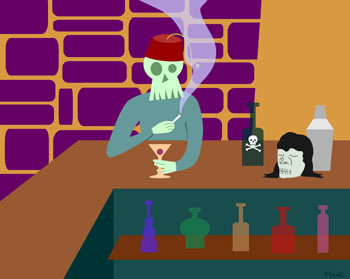
while wearing a fezz and sipping a martini.

 
Last edited by a moderator:
another cool idea is target chord tones w/ upper & lower chromatics;

for Dmin7 (d, f , a, c) you'd play notes 1 fret above & below the chord tones before hitting the chord tone

(D# Db D, F# E F, A# Ab A, etc). play this w/ a swing rhythm (dotted eights; "da-di-da-di-da")

while wearing a fezz and sipping a martini.
fezskull.jpg
fez10250_2.jpg


Last edited by a moderator:
HHB and Brooks, and others. Do you think of things like D dorian/ C major .. or do you just get a feel for the progression and jam?

 
my personal thought process is based on D blues scale superimposed over Dm6 arpeggios. I'd also honk on the tritone from f to b cause I'm like that, when it switched to Eb in the words of an old bluesman I knew "just move on up". I'm sure I would stray from dorian in the course of improvising, straight modes of any kind are beat

 
Last edited by a moderator:
I know a little about theory, but I always tend to "feel" it, instead of thinking too much.

However, now we are at it, I definitively hear Dm6 there (or even a Dm7add6), and then Ebm7.

I improvised over the song using the aforementioned progression as a reference and I did quite well with "chord targeting" --targeting chord notes from upper and lower tones and semitones.

The whole tone scale was of a good help, as it gives a great "outside-inside" flavor to your melodic lines. I use it even chromatically -- at the very end, there are only two whole tone scales, and in this case D and Eb serve as "tonal pivots" perfectly when resolving.

I jammed for a while and then realized I was also mixing Dorian and Aeolian modes (as the others said) with the blues scale -- and with whatever else I felt was right.

I'm not a jazz player though -- so I have to go back to practicing my metal chops this afternoon, because I feel to jazzy now. /emoticons/default_laugh.png

 
i think Dmin7, and play lots of stuff in and out of tune w/ it.

i just read something yesterday where someone made up a name for something i've been doing forever, a hybrid scale

1, 2, b3, 3, 4, b5, 5, b6, 6, b7, root

(basically a chromatic scale minus the b2 & #7),

this guy was calling it a "country blues scale"

(he said he made up the name for his students).

 
yeah, thats exactly what I use on blues style tunes, it's mixolydian on top of a blues scale, you get evrything but b2 and maj7, and you can move it over each chord in the blues, it's the key to the"hot" sound, that cool Steve Gaines shit. you can even use the b2 as a b9 and get everything but the maj7 going ( and then youshould use it just cause ya shouldnt )

 
Last edited by a moderator:
Those are all great posts, but I would like to add something to this discussion.

Well, I WOULD like to.

 
Hi everyone. Im Shane and Im new on here. I came here to find out some info on my Hamer but saw this thread and I think I can help.

In addition to the ideas above such as playing D dorian(C major scale ) over the D min chord and Eb Dorian(Db major scale) over the Eb min chord , You can play the full extended Arpeggio for each chord Dmin = D F A C E G B and approcaching each note from a half step below(lower neighbors) and a whole step above (upper neighbors)

Thats the first thing to grasp then try this: The coolest and easiest comping and soloing tool I know for modal vamps. I wish I could tab this out so you can see it on the neck. lets focus on the Dmin chord.

Quartal Harmony: The D dorian scale is D E F G A B C. If you Build Four note chords , with each additional note being a forth above the first note. Start with each chord on 5th fret A string. the First chrord will be D G C F. The Note D(5th fret A string), G (5th fret D string) , C (5th fret G string) and F ( 6th fret B string).

Do this on each note of the D dorian scale ascending and descending the neck.

Each chord will have only the notes of the D dorian (c major scale). The first chord is DGCF, 2nd EADG, 3rd FBEA, 4th GCFB, 5th ADGC, 6th BEAD , 7th CFBE.

You can play any of those chords over the D min chord.

You can play note sequences such as going up the first chord one note at a time and down(high to low) the second chord. The possibilities are endless with this tool.

Does that make sense the way I explained it? its difficult to explain things like this with a computer .

Also, you can do this over any G7th vamp or any time there is a static chord. it sure beats just playing one chord for 16 bars or more.

This is the sort of thing that comes more naturally to Piano players and you hear this type of comping from Guys like Mccoy tyner. The way I mentioned has you using just the inner 4 strings but when you get that try to move it around in one position and over other chords.

 
Last edited by a moderator:
Thanks to all; plenty of useful and challenging information. I found out that Bass Player magazine has a transcription of "So What" this month; plenty to work with now!

 
Hi everyone. Im Shane and Im new on here...

Each chord will have only the notes of the D dorian (c major scale). The first chord is DGCF, 2nd EADG, 3rd FBEA, 4th GCFB, 5th ADGC, 6th BEAD , 7th CFBE.
hey shane, welcome to HFC!

that's a nice sounding move.

i was just messing w/ that and it reminded me of a similar move;

although not the same voicing as the record,

i like that same 6/9 quartal voicing for the "so what" 2 chord answer to the signature bass lick,

(sounds like "bu-dum da-dum da-dum de-dum, so what" ).

but, i use a grip on the top 4 strings;

low to high E A D G (2nd & 3rd fet), then

D G C F (open & 1st fret).

goofy computer neck diagram;

------3-

------3-

---2----

---2----

--------

--------

now take that grip and starting on the 10th fret spell the dorian mode

up and down the neck with the high E string (10th fret high E is D;

move this grip up and down w/ the high E string landing on

D, E, F , G , A, B, C.

this concept of moving a set group of intervals is called "planing" (sounds like "plain-ing").

it sounds cool and is so easy, plus it adds some non mode tones.

this thread is cool!

*edited for wrong notes and to add goofy diagram

 
Last edited by a moderator:
Back
Top